Good Habits You Won’t Want to Break in 2020
April 7, 2020Stephen Covey’s the 7 Habits of Highly Effective People – Habit #1
 You may have heard about or read Stephen Covey’s book The 7 Habits of Highly Effective People. Its principles are as relevant today as they were when it was first published in 1989, and they can help all of us in our professional and personal lives. We live and work in a complex world, and Covey’s concepts provide some clarity and common sense that can help us weather challenges. In the next few issues of the Homestead Post, we’ll discuss Covey’s approach, starting with Habit #1 in this edition.
Habit #1: Be Proactive
The first habit is being proactive and responsible for what happens in our lives and at work. It’s about anticipating issues before they become problems and responding to them in a positive way that will improve the situation.
Proactive people realize they can choose and control what they say and do. They don’t blame external sources for how they behave. While some elements of a situation may be outside of their control, proactive people recognize what is within their power to change or improve, focusing their energies on those things.
This habit can be especially helpful in times of uncertainty. Take notice of when you’re proactively responding and when you’re reacting (letting circumstances control your actions and words). Being aware of how you’re spending your energy at home and work is a critical step toward becoming more proactive and intentional. A proactive mindset can help you seize opportunities and resolve challenges faster.
Stay tuned for more food for thought about Covey’s 7 Habits in our upcoming issues!
Superior Plastic Products Price Increase
 On all orders received after March 31, our prices on Superior’s vinyl products will increase by four percent. Superior has raised their pricing due to rising raw input costs.
We will honor all quotes with the old pricing for 30 days from the date we issued them.
During the last week of March, we will have updated “quick price” sheets for you. Thank you for your business!
5 Springtime Composite Decking Care Tips to Share With Your Customers
 One sure-fire way to gain new referrals is to give your existing customers knowledge to help them keep their decks looking great.
Here are some springtime deck maintenance tips to pass along to your customers:
- Sweep or use a blower to remove leaves and other loose debris from the deck surface.
- Remove mold, mildew, dirt, and grime that accumulated over winter. Follow the decking manufacturer’s instructions on what cleaners and tools are safe to use.
- Work in very small sections, especially when cleaning a deck in direct sunlight, to ensure that the cleaner (and dirt) doesn’t dry on the deck before it’s rinsed from the surface.
- Check the deck’s support components for signs of damage. Pay particular attention to the ledger board, posts, joists, stairs, and railings to confirm they haven’t split or otherwise aren’t in sound condition. Also, check flashing and fasteners that may have rusted or become loose.
- Rotate chairs, tables, pots, and other fixtures if they’ve been in the same spot for a while. If left in the same position for too long, they can cause decking to discolor or show signs of wear.
Remind customers that cleaning and maintaining decks properly will ensure they last and look exceptional longer! For more composite deck-care recommendations, contact us or visit fiberondecking.com and wolfhomeproducts.com.
Homestead Outdoor Products 2020 Open House Takeaways
February 17, 2020Thank you to everyone who attended our Open House on Wednesday, January 29! We enjoyed seeing you, and we appreciate your participation.
In case you weren’t able to join us, here are some helpful bits of insight from the presentations that day.
Selling as a Service
“Selling” shouldn’t be treated as a high-pressure game with the sole objective of getting customers to say “yes.” That irritates prospects and frustrates the salesperson.
Instead, approach selling with the goal of solving a problem for the customer. Giving solutions rather than pushing for the sale will showcase your expertise and build customer confidence. So, even if you initially get a “no” from a prospect, you’ll lay a foundation of trust that can lead to a “yes” in the future.
Branding
Every business has a brand—whether or not it is intentionally created.
Realize that your brand involves more than just the logo on your truck. It is also shaped by your company values and how you treat your customers, vendors, and employees.
Our Q&A Panel
Superior Plastic Products representatives shared recent updates to the Placid Point Outdoor Lighting system. Changes include increased brightness and an easier-to-use control system.
Railing Basics
Mike Stoltzfus of Homestead Outdoor Products walked us through the manufacturing process of railing products. Also, he reminded us how critical it is to consider the application before selecting the product.
Let’s Gear Up for Next Year
We’re already looking forward to our 2021 Open House! Feel free to call Ken Burkholder at (717) 656-9596,
extension 2, with any topics you’d like us to cover next year. We welcome your ideas!
New Product Spotlight: Wolf Serenity™ Porch With High-density Cellular™ Technology
 Looking for an attractive, durable replacement for wood flooring? Wolf Serenity™ Porch Americana collection* is a perfect fit!
You’ll find the planks easy to install, thanks to their tongue-and-groove design. Plus, when you upgrade from wood to Wolf Serenity™ Porch the transition is seamless. There’s no need to change the heights of your siding, trim, and porch posts as you would if using a thicker flooring product.
Contact us to learn more!
*Available in Pewter
Deming Principles to Drive Success in 2020
 In the past few issues of our newsletter, we shared eight of W. Edwards Deming’s 14 principles for improving productivity and work quality. In this edition, we’ll wrap up our Deming series with a focus on the final six principles.
Break down barriers between departments.
It’s critical for all people in a business to work as a team and recognize potential problems that pose risks to the production or quality of a product or service.
No matter the size of a business, it’s essential to have a free flow of information among team members. Companies need to remove the knowledge silos that prevent communication between departments. For example, a contractor’s salesperson must communicate everything discussed with a homeowner about a deck project to make sure installers will build the deck to meet the exact expectations of the customer.
Eliminate slogans, exhortations, and targets for the workforce.
Demanding perfection and putting too much pressure on performance can create strained relationships. Often, low quality and low productivity are results of faulty systems or processes rather than workers’ negligence.
While it may be simple to say, “We need to reduce mistakes,” that demand won’t happen without management giving a road map—a strategy—for eliminating mistakes. For example, you might request that both the saw-man and the measure-man check the board size before cutting. “Measure twice, cut once” is an oldie-but-goodie phrase that can solve a lot of issues.
Eliminate “management by objective” on the production floor; lead instead.
Even companies with small crews can fall into the habit of holding workers accountable for quotas and numerical goals. But quotas and goals without strategies to reach them is a lazy way to manage teams. And, it’s a sure-fire recipe for creating unhappy workers and rushed work.
Rather than announcing a number and hoping workers will step up production to reach it, fix the kinks in the system that are preventing growth. Focus on how to improve the way things get done before setting goals for how much improvement you’d like to see.
Remove barriers that rob employees of their right to pride of workmanship—and get rid of the merit or annual rating system.
This applies to hourly laborers as well as management and engineering teams. The responsibility of supervisors should be on the quality of work rather than reaching numbers.
Make sure workers have a clear understanding of what “quality” means in the context of whatever task is at hand. Tools that can help them grasp what they need to do include updated drawings, manuals, checklists, videos, and other
resources that deliver an explanation of expectations.
Institute a vigorous program of education and self-improvement.
Attend shows, read trade magazines, and provide workers with opportunities to attend training events and classes
to hone their knowledge and skills. Homestead Outdoor Products is here to help with that! We will have a breakfast-n-learn program every month this summer at the New Holland Coffee Shop. Look for details soon!
 Put everyone to work accomplishing the transformation.
By including everyone in the process of making improvements, you can set the stage for a team that works together toward the common goal of becoming better. Let your employees know how each of them is an important part of your success.
Stay tuned for our series on Stephen R. Covey’s 7 Habits of Highly Effective People, starting in our next newsletter!
How to Run a More Successful Business the Deming Way
October 16, 2019 Previously, we shared several of the 14 revolutionary process improvement principles of respected management expert W. Edwards Deming. In this issue, we continue to explore Deming’s insights and how you can use them to improve your business.
DEMING PRINCIPLE #5
Improve constantly and forever the system of production and design.
Always look for processes that need improvement. This applies to all aspects of a business—from work in the field to work in the back office.
You may have to watch areas of your business over time to detect recurring patterns. For example:
- Do material failures coincide with weather patterns?
- Do office mistakes happen more often on Mondays?
Even small changes can have a big impact on the quality of your service and productivity.
Caution: Avoid the knee-jerk reaction of adjusting work systems at the first sign of a problem. Spending energy on what may be a one-off issue is a poor use of time and effort. Instead, focus on issues that occur regularly.
DEMING PRINCIPLE #6 
Institute training.
According to Deming, “The greatest waste in America is the failure to use the abilities of people.” Training employees on the job will help you understand their potential and prepare them to perform at their best. Recognize that people learn in different ways—training may need to take different forms for different employees.
DEMING PRINCIPLE #7
Adopt and institute leadership.
Your business’s supervisors (foremen, lead carpenters, office managers, etc.), must understand the work they are managing. They must also be able to delegate work so that they can focus on the big picture. This may seem obvious, but many companies violate this principle.
Also, resist managing solely by the numbers. Realize that many factors can cause even superstar employees to have down days.
DEMING PRINCIPLE #8
Drive out fear.
Fear impairs performance and can lead to team members lying or fudging numbers when things don’t go as planned.
“I’m scared what the boss will think or do, so I’ll say the deck installation went great. We can blame the homeowner’s Labrador retriever for the scars made from the screw gun.”
False information won’t give you a true sense of what’s going right or wrong in your business.
Also, keep lines of communication open between you and your employees so that they feel comfortable coming to you with questions and concerns.
Read more about Deming’s principles at deming.org.
Product Spotlight: QUIKRETE® Fast-setting Cement
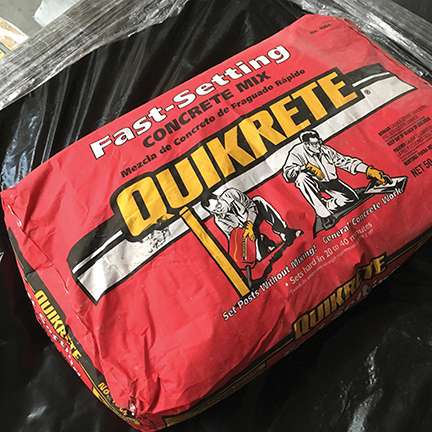 We are now stocking Fast-setting Quikrete® Cement. Specially formulated to set within 10 to 15 minutes, it is ideal for repairing edges on curbs and concrete steps. It’s also a great match for setting posts in small fencing projects and building footers in areas that don’t require a footer inspection.
Tips for Getting Satisfied Customers to Leave Online Reviews
 According to a survey by BrightLocal (a marketing software development company), 86 percent of consumers read reviews for local businesses. As a contractor, you’ll want to pay attention to this statistic. Most people look at online reviews before they decide what products and services they will buy and from whom they will buy them. Therefore, online reviews are essential for doing business in this digital world.
Some customers—being proactive—will post reviews on websites such as Facebook, Google My Business, Yelp, Angie’s List, Houzz, and others. But some may need prompting.
How can you get more of your customers to share about their stellar experience with you?
Just ask!
Seventy percent of customers that are asked to write a review will write one, according to BrightLocal’s survey.
Some tips for getting customers to leave reviews include:
ASK PROMPTLY. Customers will be more likely to leave a review when the details of their interaction with your company are still top of mind.
SEND A REMINDER. If it has been several days or a week since you requested a review and none was written, consider sending an email reminder.
MAKE SURE ASKING FOR A REVIEW IS ALLOWED. Although some review websites encourage businesses to ask for reviews, some (Yelp, for example) prohibit it. Read a review site’s terms of service before asking customers to leave reviews on it.
Source: https://www.brightlocal.com/research/local-consumer-review-survey/#local-business-review-habits
Tips for Staying Hydrated in the Summer Heat
August 2, 2019A study found that 75 percent of people suffer from some degree of dehydration. Add the hot sun, high humidity, and sweltering temperatures into the mix and you get a recipe for disaster.
How can you know if you are dehydrated? Early warning signs include:
- Thirst
- Dry mouth
- Fatigue
- Muscle cramps
- Dizziness
More serious symptoms such as no longer sweating, rapid heart rate, confusion, and difficulty walking can occur as dehydration worsens.
How can you stay hydrated? 
Keep plenty of water (and other beverages with water) on the job site and drink them gradually throughout the day. Also, pack fluid-rich foods (such as fruits, vegetables, salad, and applesauce) for snacks and lunch.
The amount of water people need varies from person to person, but according to the Mayo Clinic, the general rule is eight 8-ounce glasses of water each day. Keep in mind that heavy sweating will increase your body’s need for fluids, so you may have to drink more in the heat of summer.