What It Takes to Go from ‘Good’ to ‘Great’
March 29, 2022The Right People
 In his book Good to Great: Why Some Companies Make the Leap . . . and Others Don’t, author and researcher Jim Collins discusses seven key traits of highly successful companies.
- Level 5 Leadership
- First Who, Then What
- Confront the Brutal Facts
- Hedgehog Concept
- Culture of Discipline
- Technology Accelerators
- The Flywheel
In this article we’ll take a look at the second characteristic that’s critical for going from good to great.
GREAT COMPANIES’ TRAIT #2: FIRST WHO, THEN WHAT
Collins advises business owners to put “who” questions before “what” decisions. “What” decisions—strategy, vision, tactics—will be easier to tackle when a company has the right people on board.
Whether a contracting business has a handful of workers or hundreds of employees, having the right people on a team can make or break productivity and performance. A good—even a genius—leader cannot compensate for the problems created by hiring individuals who are not a good fit.
Consider a business with four workers. . . one “bad apple” represents one-quarter of the workforce. The company’s owner or a supervisor will have to spend a lot of time managing that person. Also, that individual’s poor attitude or shoddy work can quickly hurt the company’s reputation and lower employee morale.
How can you avoid this trap?
- Focus on building a team of capable people who share your company’s values and work ethic.
- Be choosy about whom you hire. Don’t be in a rush to fill open positions with “warm bodies.” With labor shortages hurting our industry, it may be tempting to hire the first applicants in the door. Instead, take your time and assemble a team that will work well together for the long haul.
- Hire for the attitude, train for the skill. While people can learn many trade skills, a positive outlook and motivation to do an excellent job come from within.
- Compensate your employees at or slightly above the “going rate.” Remember that no matter how much you pay, the right people will perform their best, and the wrong people won’t care about their impact on your business.
Stay tuned for more about going from good to great! Next time, we’ll talk about the third characteristic, “Confront the Brutal Facts.”
Marketing Tips to Start the Year Off on the Right Foot
February 8, 2022By: Stuart Jeffcoat—CEO, Burgard
Can you believe it’s already 2022?! As folks have returned from the holidays and are back in their regular daily routines, many are thinking about upcoming home improvement and building projects. It’s time for contractors to seize the opportunity by launching their sales and marketing efforts for the New Year.
But where to begin? So many tactics and strategies exist to kick-start the sales cycle! To help make the process less daunting and to get your year off to a strong start, we’re sharing some time-tested tips.
1. Outline your sales process.
Likely, the journey from that first phone call with a prospect to the final payment is similar from customer to customer. Write down the process and keep track of how it impacts your business; doing so will provide several benefits:
- Efficiency: By identifying what steps you take with clients, you can remove parts of the process that are redundant or aren’t offering value.
- Consistency: While not every customer is the same, providing a consistent experience is a great way to ensure top-quality service. By observing what you’re doing, you can concentrate on repeating good habits and eliminating bad ones.
- Improvement: When you have a handle on what’s happening in your process and the outcomes, you have the information you need
to improve. For example, if your sales numbers are lagging, or you simply want to grow your business, identifying what’s working and what’s
not is the first step.
2. Understand your market.
Clients come to you instead of the other guys for a reason. Maybe you have extensive expertise and experience in certain projects, or perhaps you provide a price point that your competitors can’t match. Regardless of your distinctive competitive advantage, understanding your market allows you to:
- Communicate the value you provide (and your company values): Sharing what you do best and what your company stands for gives prospects a reason to choose you over the competition.
- Understand what you DON’T do: There are probably types of jobs you don’t like, or that aren’t your specialty, or that don’t turn a healthy profit. Deciding to pass on that work can save you time, money, and hassles. And it will allow you to focus on what you do well.
3. Get the word out.
Sales and marketing aren’t just for big companies with large teams and massive budgets. In 2022, it’s essential to put yourself out there so that prospective customers know you exist. Marketing your company is also critical for reminding past customers you’re still here to serve their needs.
Ways to promote yourself, regardless of the size of your business, include:
- Website: Websites come in all shapes and sizes. Some are big, robust, and expensive—designed and maintained by a professional website developer. Others are cheap and simple—created using free tools (like WIX). Whatever option you choose, having a website is an important tool to make your company visible and to connect with prospects and customers.
- Google My Business™ profile: Most consumers find service providers in two ways:
- Asking friends.
- Searching on Google. Having a Google My Business profile helps to ensure your business turns up on Google when folks search online for contractors in their area. The best part? It’s free!
We wish you a successful 2022! If you have questions about any of these strategies or want to discuss your marketing challenges, feel free to contact me: stuart@burgardagency.com or 717-693-2204.
Best Wishes Dave and David!
We’re saddened to announce Dave Wenrich is leaving Homestead Outdoor Products. Dave and his family have purchased a small farm in the Mifflintown area, where they expect to settle down to country life. David Batturs has also resigned his position, citing health issues. We wish both Dave and David the best with their future endeavors.
What It Takes to Go from ‘Good’ to ‘Great’
Humble Yet Driven Leaders
The book Good to Great: Why Some Companies Make the Leap . . . and Others Don’t sheds light on the shared characteristics of businesses that achieve exceptional success. Jim Collins, author and researcher, identifies seven key traits that enable companies to transition from doing okay to doing phenomenally well.
- Level 5 Leadership
- First Who, Then What
- Confront the Brutal Facts
- Hedgehog Concept
- Culture of Discipline
- Technology Accelerators
- The Flywheel
These may all sound a bit cryptic! That’s why, in this article and several others to come, we will discuss the characteristics that Collins discovered so that you can consider them as you strive to improve and grow your business.
Great Companies Characteristic #1: Level 5 Leadership
Collins describes five levels of leadership that embody different skills and strengths. All levels are important for business owners to achieve and maintain. But getting to Level 5 is especially critical for taking a company from good to great.
- Level 1: Highly Capable Individual—Contributes their work ethic, talents, and knowledge to advance the company
- Level 2: Contributing Team Member—Applies their individual capabilities to group efforts and objectives and collaborates effectively in group settings
- Level 3: Competent Manager—Effectively organizes people and other resources to further company objectives
- Level 4: Effective Leader—Stimulates higher performance standards by motivating others to work together toward a clear and compelling vision
- Level 5: Executive—Embodies a powerful blend of unwavering will and humility, a combination that develops trust and inspires others to aspire to excellence
Contracting companies might find it difficult to transition from the first three levels to the fourth and fifth. In small businesses, owners are often tasked with working heavily in the business (meeting with customers, writing quotes, doing the construction, etc.) to get jobs done and keep operations running smoothly. But working on the business (planning, strategizing) to develop a clear and compelling vision is critical, too. So is communicating that vision and having the right mindset and demeanor to energize others in the company to want to help fulfill it.
So, what can you do if you haven’t quite reached Level 5? Here are a few tips to consider:
- Delegate work to others in your business who have the necessary skills and knowledge—and don’t micro-manage!
- Take time to think about what you want your business to achieve. What vision do you have for your company?
- Establish KPIs (Key Performance Indicators) that allow you to set benchmarks for success, measure performance, and track what’s working and what isn’t.
- Give credit where credit is due. Acknowledge a job well done and show appreciation for your team’s hard work.
- Be confident but not cocky. Feel gratified by your achievements but keep focus on how everyone in your business has contributed collectively to your success.
Stay tuned for more about going from good to great! Next time, we’ll talk about the second characteristic, “First Who, Then What.”
Featured Homestead Outdoor Products Video: What is graspable handrail?
November 23, 2021 Check out our new video at homesteadoutdoorproducts.com/videos, featuring information to help contractors stay on top of building code requirements. Watch and listen as Homestead Outdoor Products’ Ken Burkholder explains the criteria that handrails must meet and where they must be installed to comply with IRC specifications.
Tune in to our other helpful videos, too, and watch for more to come!
Fiberon® Makes Marketing Hassle-free

Contractors don’t often have much time (or big budgets) for marketing and advertising efforts. Nor do most have writing or graphic design skills in-house to create professional marketing materials. However, Fiberon® makes it a breeze for contractors to overcome those hurdles with turnkey ads and pre-made social media content!
Through Fiberon’s Digital Vault and free online portal, you can download various materials and easily and quickly customize them to use in your marketing efforts.
- Digital ads
- Print ads
- Billboard ads
- Radio ads
- Yard signs
- Flyers
- Facebook, Instagram, and Twitter posts
- And more!
Get started by reviewing Fiberon’s resources for professionals at fiberondecking.com/professionals.
Product Spotlight: Wolf Portrait™ Siding

Wolf Portrait™ High-Density Cellular™ Siding has the rich look of expensive wood siding while offering superior strength and durability over wood, vinyl, and fiber cement siding products.
Homeowners will love this siding’s authentic high-definition wood-grain texture and its low-maintenance resiliency. There’s no rotting, splintering, chipping, or peeling—and it’s insect-resistant as well.
You’ll love that it’s easy to install and doesn’t break or produce the harmful dust created when using fiber cement siding. Unlike other siding products, Wolf Portrait Siding does not require panel overlapping or extensive caulking. And it features Wolf’s industry-leading INFINITYSEAM™ Siding Seam Plates, which provide high board-to-board locking adhesion for cleaner, tighter seams.
Wolf Portrait Siding’s high-density cellular structure makes it ultra-resistant to water absorption. Customers won’t have to worry about mold and mildew or swelling and cracking. The siding’s high tensile strength provides the peace of mind that it will withstand wind, weather, and years and years of use.
Ready to offer this stunning, innovative new siding product to your customers? Homestead Outdoor Products has it in stock now in the fade-resistant colors of Riverstone and Graphite!
Contact us to learn more.
Get Things Done—Step 5: Engage
 “Engage,” the fifth step of the five-step process that David Allen describes in his book Getting Things Done: The Art of Stress-Free Productivity is mission-critical for contractors. It’s all about making wise choices to ensure you spend your energy on what’s most important at any given point in time.
“Engage” entails deciding what action you will do right now, based on what you’ve captured, clarified, organized, and reflected on.
THE FOUR-CRITERIA MODEL FOR CHOOSING ACTIONS IN THE MOMENT
One of Allen’s models for successfully engaging involves considering four criteria when choosing what action you should take.
- Context: Your work setting—and tools and resources available there—will influence your actions. Not all tasks can be done from anywhere at any time. For example, if you’re in your office, furthering the build of a customer’s deck isn’t an action you can accomplish at that immediate moment.
- Time Available: What’s next on your schedule will dictate what you can do right now. For example, if you have a meeting in 10 minutes or are due to be at a job site in a half-hour, you may want to wait to tackle preparing a new customer proposal. If you rush through it, you might miss critical details and make costly mistakes.
- Energy Available: Some activities require that you’re physically or mentally rested and refreshed to do them well. So, if you need to call or meet with a difficult customer, you may want to hold that conversation in the morning before the day’s other demands have tested your patience.
- Priority: After considering the first three criteria, you can determine the order in which you’ll act on your tasks. Which option is the most urgent and will yield the biggest payoff if you do it right now? You’ll need to use good judgment in deciding what to do first, second, third, etc., to advance you toward your goals.
We hope you found this article series on Getting Things Done helpful. Stay tuned for more tips and insight for running a successful business in future articles!
Product Spotlight: Chesapeake Series Railing by Key-Link™
September 28, 2021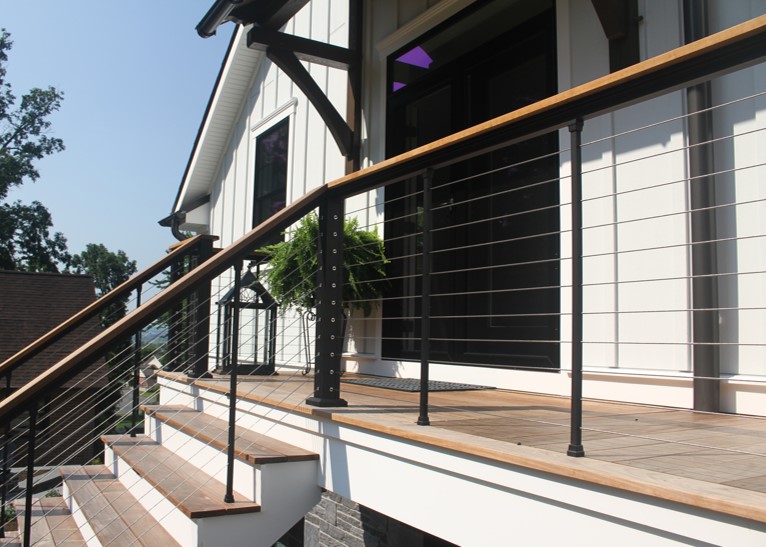
Homeowners who enjoy entertaining friends and family on their decks will love the new Key-Link™ Chesapeake Series railing! The attractive top rail, uniquely designed for deckboard, provides a perfect place for food plates and beverages while your guests are socializing.
Installation couldn’t be easier! Simply lay a composite, PVC, or wood deckboard on the top rail profile and fasten it. The railing comes with pre-drilled holes every 12 inches (in hidden channels). Fasteners are included, and installers don’t have to deal with special brackets.
CHESAPEAKE SERIES RAILING INCLUDES:
- Top rail profile of choice
- Bottom rail (not applicable with horizontal cable)
- Vertical cable or square infill
- Brackets and fasteners
- Comprehensive installation guide
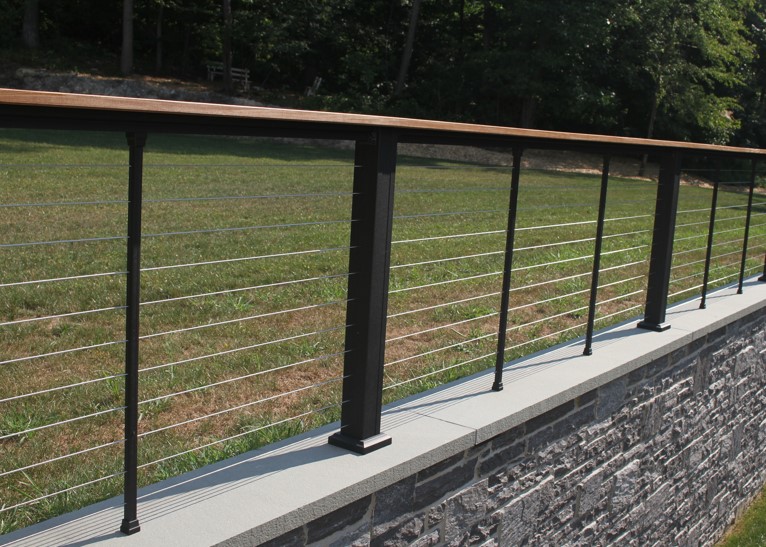
Chesapeake railing, manufactured locally in New Holland, Pennsylvania, comes in one standard color (textured black)* and three standard infills: square balusters, horizontal cable, and vertical cable. Presently, Chesapeake works best on decks with 90-degree angles. Eventually, Key-Link will offer swivel brackets to accommodate decks with different angle configurations. More accessories are on the way, too.
Key-Link has specially engineered Chesapeake to make drink-rail installation easy for contractors and give homeowners the ultimate outdoor entertaining space they’ve dreamed of!
For more information and to order this sleek and functional product, contact us!
*Additional colors available via special order
Perspective: Ebb & Flow of Building Materials Prices
“The only constant in life is change.”
That quote by the Greek philosopher Heraclitus has become especially true for contractors and their customers! The cost of building materials keeps going up and down as the pandemic throws more twists and turns our way.
We’re all frustrated with the pricing uncertainty. It’s difficult to plan ahead and even more challenging to explain increases to homeowners.
Fortunately, the manufacturers that Homestead Outdoor Products works with have been very conscientious about keeping us informed. They do their best to provide products reliably and as affordably as possible.
Still, changes happen—upward and downward—when the supply/demand equilibrium goes out of balance.
SCENARIOS WHEN PRICES RISE
- Demand has skyrocketed.
- There are backlogs or bottlenecks in production because of unanticipated demand or a drop-off in the workforce.
- Transport and delivery delays or cancellations occur (of raw materials or finished products).
SCENARIOS WHEN PRICES FALL
- Excess inventory needs to be moved.
- There’s less demand for the products.
- Something new and improved has been introduced to the market.
The evolving pandemic will continue to influence building materials pricing.
SO, WHAT CAN YOU DO?
Stay in the know about where the industry is trending—and watch for notifications from us about any upcoming changes. Some more changes will be inevitable, but find peace of mind in knowing that our free-market economy will help prices level out in the long run.
We’re fortunate to have the advantage of LOTS of supplier competition in the building materials industry, which helps ensure that cost increases aren’t in vain and that decreases will follow when economic conditions improve.